City of Hamilton : 1/48th Hasegawa P-51D Mustang
First released in 1991, the 1/48th Hasegawa P-51D Mustang set a new high standard for Mustangs in this scale. Typical of Hasegawa, their kit had very fine surface details with nice crisp moulding and good fit in the parts department. Having said that, Hasegawa didn't get everything correct in their kit with the wheel wells and some minor fit issues being a miss.

Notable Kit Features:
Relatively low parts count
Nice raised details in the cockpit and instrument panels
Finely engraved surface detail
Positionable radiator vent
Both shrouded and unshrouded exhausts provided
Both cuffed and un-cuffed props provided
Two styles of blown canopies provided
Wing pylons have separate anti-sway braces
Two types of wing tanks provided
Nicely detailed weapons include, bombs, bazooka & rockets (standard rockets have separate rails that can be installed independently)
Build Inspiration:
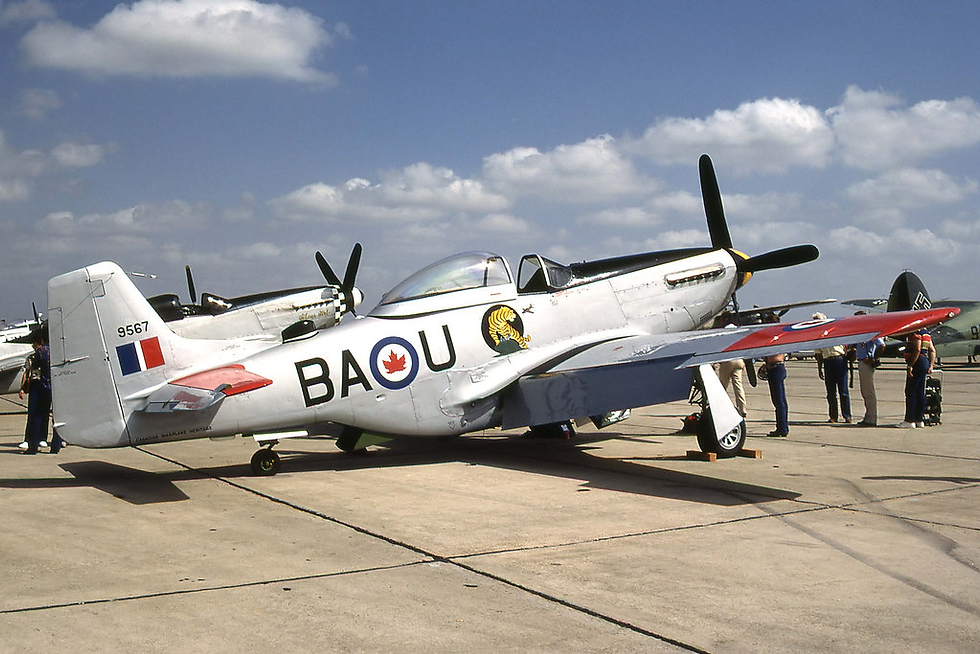
Post WWII there were many RCAF units that flew the P-51D Mustang. When Leading Edge Models released their RCAF P-51 (Eastern & Western) Decal sets, it left me with too many great decal options to choose from, and not enough unbuilt Mustang kits. I decided a Tamiya vs. Hasegawa Mustang model comparison was in order. The Leading Edge decals are beautifully done and represent a number of great post-WWII P-51D Mustang schemes flown in Canada. For this kit build I selected one of the RCAF 424 Squadron "City of Hamilton" Mustangs displaying their tiger mascot emblem beneath the cockpit.

Heads-Up Report:
Wheel wells are inaccurate, being far too shallow as well as incorrect in details
Chin cooler intake required some sanding and filler
Lower radiator intake & exhaust areas required sanding and filler

Notes: Panel lines on the wing can mainly be filled if you are building a newly delivered type, as filler was used to refine the laminar flow aspect of the wing (the gun access panels, which would be accessed often, lost this panel fill). The wings of Mustangs were mostly primed and painted silver, and not natural metal as was the case with the fuselage
If you are interested in replicating the silver painted and natural metal finish (NMF) areas of the P-51D Mustang, the photo below sheds a lot of light on the subject. The typical finish of the P-51D is highlighted in the photo and explained below:
Blue areas - two layers of sprayed putty and polished for the smooth surface entirely with no rivets seen. Then sprayed with a silver paint
Green areas - one layer of sprayed putty and polished for the smooth surface entirely with no rivets seen. Then sprayed with a silver paint
Yellow areas - a silver paint only

Kit Additions / Modifications:
Used aftermarket decals from Leading Edge Models which were excellent http://lemdecal.com/P-51%20Mustang%20RCAF%2048.81.html

Finishing:
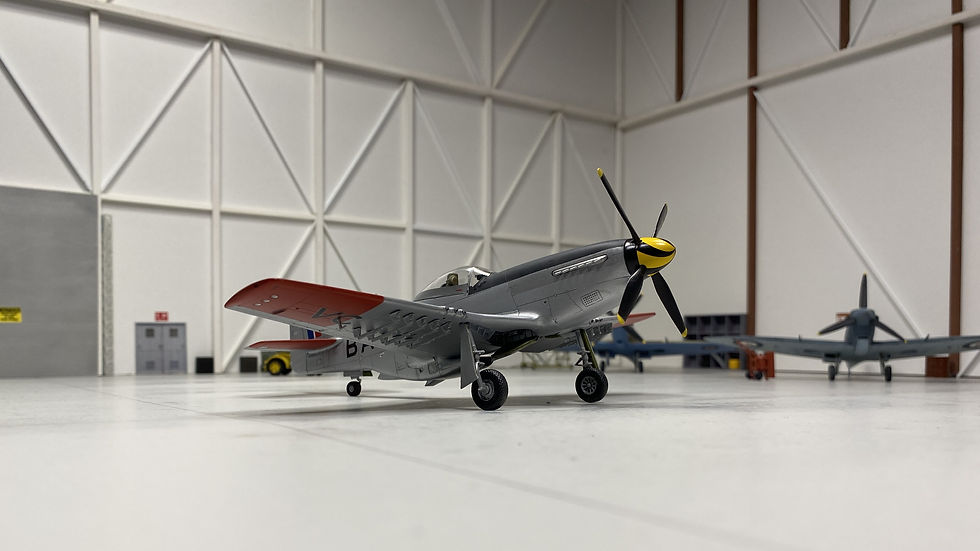
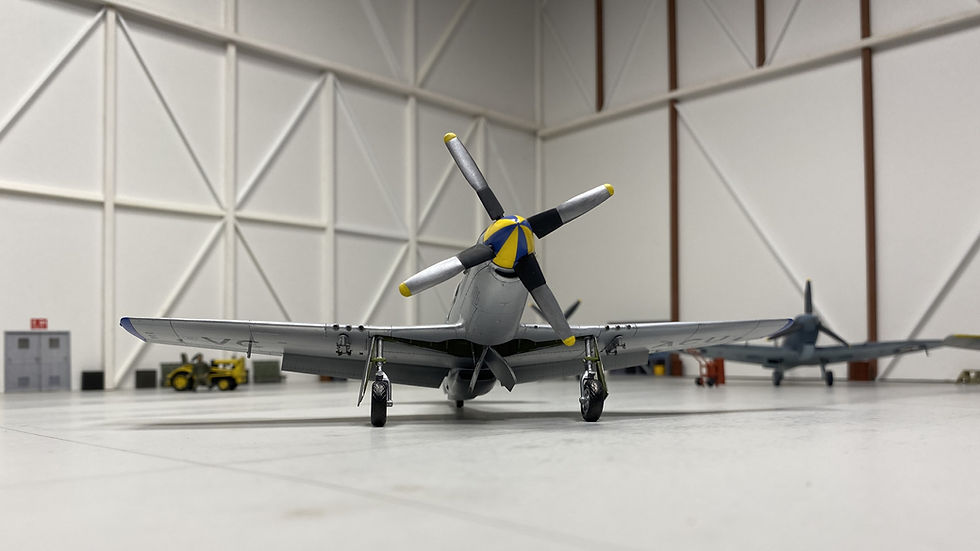
The paint scheme for this aircraft is a NMF (Natural Metal Finish) with some red panel areas for highlight. The metal look was achieved utilizing the water-based Vallejo Model Air metals. I toned some of the panels darker around the exhausts by adding a drop of black to add some metal type variation where needed. I painted the red wing and tail trim areas as well as the black anti-glare panel and spinner. The Leading Edge Model decals were quite thin and flexible enough to adhere to the curves that were presented, especially on the propeller spinner! A dark gray panel wash was used followed by the traditional wipe-down with the airflow to get a minimalist weathered look. Once all that cured, a Model Master semi-gloss coat was sprayed over everything to seal the decals in, followed by a matte coat on the anti-glare panel. Afterwards just a few antennas to get in place, as well as the gear details, and this Mustang was ready to join her sister squadron Mustang in The Hangar.

The After-Build Report:
For a thirty-five year old kit, the 1/48th Hasegawa P-51D Mustang is holding up alright, and therefore remains on my recommended kit list. Its main competitor at a comparable price point is the Tamiya kit. The two kits are similar, each with their pros & cons. IMO - Hasegawa's cockpit has slightly better detail, store options are much broader and overall detail is slightly better. The cockpit canopy/rails molded as one piece provides a seamless fit, the inclusion of clear navigation light parts is a bonus and the gear detail is more refined than the Tamiya kit, however fit is slightly worse than the Tamiya around the nose and intake areas and the wheel wells are noticeably shallow (no dropped flaps option on the Hasegawa kit either). Depending on what your priorities are and which kit is available, either kit is nice.
There are newer Mustang models in 1/48th scale that can now better this old Hasegawa kit (mainly in the cockpit, surface features and wheel well details), the Eduard, and Meng models being prime examples, however this Hasegawa model still remains a decent competitor at its typical lower price point.
Feel free to comment or ask any questions - Keep on building, gain experience, challenge yourself if you like, but try not to stress yourself out over the build - it is supposed to be an enjoyable hobby after all - Cheers



Comments